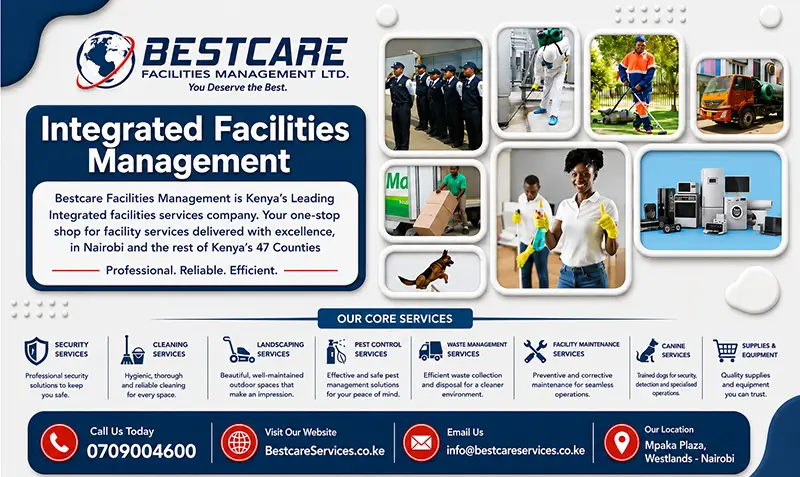
As Nairobi’s skyline and property landscape evolve, many homeowners, developers, and businesses find themselves needing to clear old structures, make way for new builds, or reconfigure existing spaces. Demolition is no longer a simple “knock‑it‑down” exercise; it requires careful planning, safety controls, and debris management to protect workers, neighbours, and the environment. Bestcare Facilities Management offers professional demolition services in Nairobi and across Kenya, combining hard‑facility‑management expertise with structured workflows to handle everything from small‑scale removals to complete building knock‑downs.
Why professional demolition matters
Unplanned or DIY demolition can expose a site to structural hazards, flying debris, and legal issues with local authorities. In Nairobi, buildings range from low‑rise residential blocks to high‑density apartments and commercial structures, each with different load‑bearing configurations and utility connections. A professional team like Bestcare ensures:
-
Structural assessment before tear‑down to avoid sudden collapses.
-
Safe isolation of water, electricity, and gas lines.
-
Proper containment of dust and noise, especially in estates and busy CBD areas.
-
Efficient debris removal and disposal in line with local waste‑management regulations.
This approach minimises risks, keeps adjacent properties safe, and prepares the land for the next phase of construction or landscaping.
Demolition services provided by Bestcare (numbered list)
Bestcare Facilities Management offers a comprehensive range of demolition‑related services tailored to Nairobi and surrounding areas. Below is a clear numbered list of what the company covers:
-
Residential building demolition – Knock‑down of old houses, bungalows, and flats for replacement or redevelopment.
-
Commercial structure demolition – Safe removal of office blocks, shops, warehouses, and light‑industrial structures.
-
Partial or selective demolition – Removing specific sections of a building (e.g., partitions, extensions, or outdated wings) without affecting the main structure.
-
Minor structure and wall demolition – Breaking down fences, boundary walls, sheds, and internal partitions for re‑planning.
-
Roof and ceiling demolition – Removing old roofs, gutters, and ceilings to make way for new roofing or ceiling systems.
-
Asbestos and hazardous‑material handling (where applicable) – Identification and engagement of specialist subcontractors for asbestos or other regulated materials.
-
Debris removal and site clearing – Loading, hauling, and responsible disposal of rubble and demolition waste.
-
Dust and noise control during demolition – Use of tarps, water spraying, and controlled‑break strategies to reduce environmental impact.
-
Site preparation after demolition – Basic levelling and cleaning to leave the plot ready for foundations, paving, or landscaping.
-
Post‑demolition cleaning and post‑construction cleanup – Final sweep and deep‑cleaning of the area and adjacent shared spaces.
Estimated costs of demolition services in Nairobi
Demolition pricing in Nairobi depends on the building type, size, height, location, and how much debris must be carted away. The table below gives a rough cost range for typical projects handled by Bestcare Facilities Management.
These figures are indicative and may vary with site access, proximity to Nairobi CBD, and any special precautions (e.g., near‑railway, near schools, or high‑traffic roads). Bestcare provides no‑obligation site visits and fixed‑price quotations so clients know the total cost before work begins.
How Bestcare ensures safe, efficient demolition
Bestcare’s demolition process is structured into clear stages:
-
Initial site survey and risk assessment – Technicians inspect the building, identify load‑bearing elements, and plan safe break‑down sequences.
-
Planning and permit coordination – Where required, Bestcare liaises with the client on local‑authority notifications and basic permit‑type checks.
-
Utility isolation and fencing – Electrical, water, and gas lines are secured, and temporary fencing and warning signs are installed.
-
Controlled knocking and debris management – Demolition teams use a mix of manual tools and small plant equipment to break down the structure in a controlled manner and load debris efficiently.
-
Final cleaning and handover – Once rubble is hauled away, the site is swept and left ready for the next occupation or construction phase.
By integrating demolition with its broader hard‑and‑soft‑FM services, Bestcare can also coordinate follow‑up work such as post‑construction cleaning, landscaping, security setup, or facility management, giving property owners a single‑point partner from knock‑down to full occupancy.
If you are planning to clear an old building, remodel a space, or prepare a plot for new construction in Nairobi, Kiambu, or elsewhere in Kenya, Bestcare Facilities Management offers a structured, safety‑first approach to demolition that keeps projects on time, within budget, and compliant with local standards.